A USA and Canada guide to legal wireless audio frequencies, including the 600 MHz duplex gap, guard band and banned wireless mic ranges.
You step onstage, hit the first glorious note, and your tone disappears like the singer when it is time to carry the PA. Battery? Fine. Cable? Not guilty, because there isn’t one. The drummer looks confused, which is normal.
The real suspect is wireless frequency rules. In the USA and Canada, wireless mics, guitar systems, bass systems and IEMs can still use certain license-free UHF frequencies, but the usable space is smaller, stricter and more crowded than it used to be. Some older 600 MHz systems are now illegal. Others are legal, but still not clean, because local TV stations, cell signals, venue rigs, other bands and tiny safety-vest RF gremlins may already be stomping around in the same air.
Quick Answer: What Does “License-Free UHF” Actually Mean?
The clean answer depends on where you are playing. The U.S. and Canada are similar enough to confuse people, but different enough to make copy-pasting a frequency plan a bad idea. In the U.S., the FCC lists wireless microphone operation in TV-band spectrum including 470-608 MHz, the 614-616 MHz guard band, and the 657-663 MHz unlicensed portion of the duplex gap. The FCC also separates 653-657 MHz for licensed use, not casual license-free operation.
License-Free UHF Frequencies in the USA
| Frequency Range | U.S. Status | Musician Translation |
|---|---|---|
| 470-608 MHz | Unlicensed use allowed where locally available | Main UHF TV-band playground |
| 614-616 MHz | Unlicensed guard band use | Tiny but useful slice |
| 653-657 MHz | Licensed use only | Not for casual license-free users |
| 657-663 MHz | Unlicensed upper duplex gap | Popular modern narrow slice |
| 617-652 MHz and 663-698 MHz | Not for regular wireless mic, guitar or IEM use | The “your old rig may be toast” zone |
Licence-Exempt UHF Frequencies in Canada
In Canada, ISED says wireless microphones can continue to operate on a licence-exempt, no-protection, no-interference basis in the TV broadcasting bands, including 470-608 MHz, and are also permitted in the 614-617 MHz guard band and 652-663 MHz duplex gap, subject to technical rules.
| Frequency Range | Canada Status | Musician Translation |
|---|---|---|
| 470-608 MHz | Licence-exempt use allowed where locally available | Main UHF TV-band space |
| 614-617 MHz | Licence-exempt guard band use | Similar to the U.S., but not identical |
| 652-663 MHz | Licence-exempt duplex gap use, subject to rules | Canada’s duplex gap plan differs from the U.S. split |
| 617-652 MHz and 663-698 MHz | Mobile broadband bands | Avoid for wireless audio |
And now for the part that saves gigs: these bands are not private lanes. They are shared spaces. Your wireless system can be legal and still get stomped by local TV stations, another band’s IEM rack, the venue’s house wireless mics, poor frequency coordination, bad antenna placement, or a cheap receiver with the RF manners of a raccoon in a dumpster. Legal gets you through the front door. Clean, coordinated and reliable is a whole different beast.
Why Did Old 600 MHz Wireless Systems Become Illegal?
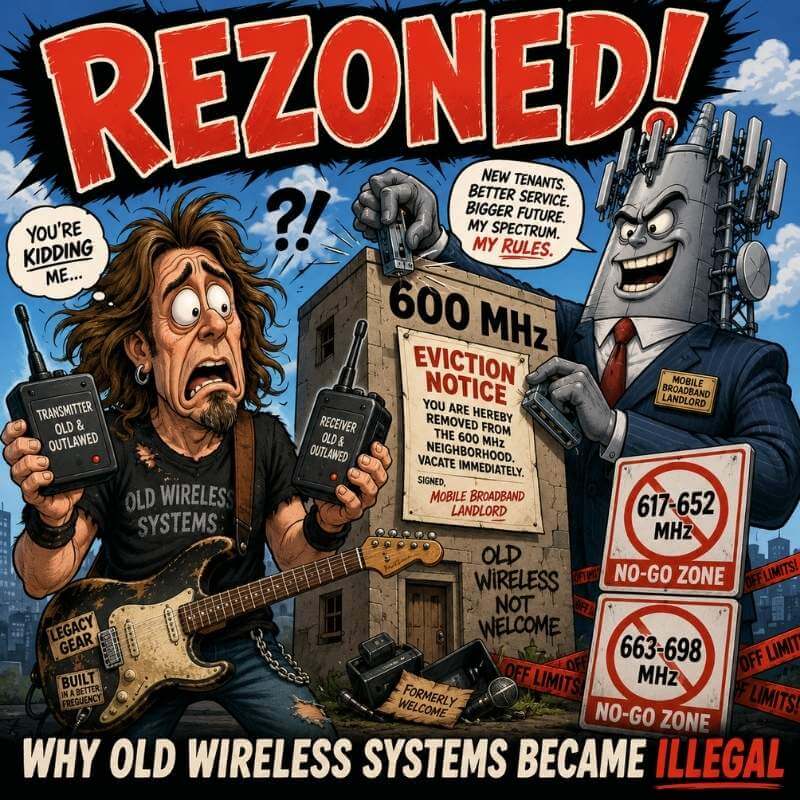
Old 600 MHz wireless systems became illegal because parts of that spectrum were repurposed for mobile broadband after the 600 MHz auction and TV repack. Translation: the government changed the neighborhood zoning.
Your old wireless rig did not “go bad.” It did not wake up and choose crime. The block got rezoned, and now your guitar transmitter may be rehearsing in a cell tower’s living room. In the U.S., many wireless mics using 617-652 MHz and 663-698 MHz had to stop regular operation after July 13, 2020.
The No-Go 600 MHz Zones
For U.S. musicians, the big danger zones are:
| Frequency Range | Current Reality | Musician Translation |
|---|---|---|
| 617-652 MHz | Repurposed for 600 MHz wireless broadband service | Do not use for regular wireless audio |
| 663-698 MHz | Repurposed for 600 MHz wireless broadband service | Also do not use for regular wireless audio |
| 614-616 MHz | Guard band exception | Small legal slice, but not a free-for-all |
| 657-663 MHz | Unlicensed upper duplex gap | Legal for certain unlicensed wireless mic use |
| 653-657 MHz | Licensed-only portion of duplex gap | Not casual license-free territory |
That is why “my wireless still turns on” is not the same as “my wireless is legal.” A transmitter does not know the law. It will happily broadcast on a banned frequency with the confidence of a guitarist playing Wonderwall at a funeral. You have to check the frequency range printed on the receiver, transmitter, battery compartment or manual, especially if the system was bought before the 600 MHz transition.
What About 700 MHz Wireless Gear?
The 700 MHz band is even deeper in the retired gear graveyard. The FCC prohibited wireless microphones and similar devices from operating in 698-806 MHz, known as the 700 MHz Band, back in 2010. Canada also repurposed major 700 MHz ranges for mobile broadband services, so old 700 MHz wireless mic systems are generally not a good bet for North American musicians.
The short version for the gig bag: if your old wireless microphone, guitar system or IEM pack lives in the wrong part of 600 MHz or 700 MHz, treat it like a sketchy van with no brakes. It may still move, but that does not mean you should take it on the highway.
The 600 MHz Duplex Gap Explained Without an Engineering Degree
The 600 MHz duplex gap sounds like something an RF engineer says right before everybody else quietly refills their coffee. In plain English, it is the narrow slice of spectrum that sits between the mobile downlink and uplink blocks in the 600 MHz band. So no, it is not the whole 600 MHz band. It is the skinny alley between two cellular highways, and wireless audio is allowed to use parts of that alley under specific rules. The FCC defines the 600 MHz duplex gap at 652-663 MHz, and the 600 MHz guard band at 614-617 MHz, but not every part of those ranges is equally open to every type of user. (ecfr.gov)
What Is the 600 MHz Guard Band?
The guard band is a buffer zone. Its job is to help keep different services from stepping on each other, especially around the edge of the mobile broadband bands. In the United States, wireless microphones are allowed to operate in the 614-616 MHz portion of the guard band. In Canada, the guard band is broader on paper at 614-617 MHz, although technical rules apply there too. (law.cornell.edu) (ised-isde.canada.ca)
That little difference matters. It is one more reason a musician should not assume that a U.S. frequency chart and a Canada frequency chart are interchangeable twins. They are more like cousins who dress alike at family events and then argue about hockey.
What Is the 600 MHz Duplex Gap?
The duplex gap is the space between the mobile downlink and uplink portions of the 600 MHz service band. In the U.S., this is where the important split happens:
| Frequency Range | U.S. Status | What It Means |
|---|---|---|
| 653-657 MHz | Licensed use only | Not general license-free territory |
| 657-663 MHz | Unlicensed use allowed | The main license-free duplex gap slice |
So if someone says, “my system works in the 600 MHz duplex gap,” that statement is only useful if they also say which part. That is the difference between “I live near Nashville” and “I live in a van behind a Waffle House.” Details matter.
In Canada, ISED allows wireless microphones in the 652-663 MHz duplex gap, subject to technical rules designed to protect adjacent mobile services. (fcc.gov) (ised-isde.canada.ca)
Why 657-663 MHz Gets So Much Attention
The 657-663 MHz slice gets so much love because it is one of the few remaining modern UHF spaces where unlicensed wireless audio can legally operate in the U.S. That makes it very attractive for wireless microphones, guitar systems and other audio links. Manufacturers know this, which is why you will see newer systems designed around that range or around similarly narrow legal slices.
But here is the catch, and it is a big one wearing tiny pants: 657-663 MHz is only 6 MHz wide. That is not a giant playground. It is more like one decent-sized parking lane. So yes, it can be useful, but channel count is limited, coordination matters, and “up to X systems at once” always depends on the specific gear, local RF conditions and how intelligently the system uses spectrum. This is exactly why the duplex gap is interesting, but also why it is not a magical cheat code.

Legal Does Not Mean Clean: Why Wireless Audio Still Drops Out
This is where a lot of musicians get sucker-punched. We spend all this energy asking, “Is this wireless frequency legal?” which is important, obviously, but legality is only the door key. It gets you into the building. It does not guarantee the room is quiet, the PA works, the bartender knows what an XLR cable is, or your singer will stop cupping the mic like it owes him money.
A wireless microphone/guitar system or IEM pack can be operating in a legal UHF range and still drop out, hiss, splatter, mute, burp, gargle or vanish mid-song. Why? Because wireless audio lives in shared spectrum.
Other Wireless Systems Are the Silent Bandmates From Hell
Other wireless audio systems can be a problem too. Churches, theaters, conference centers, wedding bands, festivals, schools, livestream crews and venue house systems may all be using wireless microphones, IEMs, intercoms, lav packs or guitar systems in the same general neighborhood.
And here is the fun part, by “fun” I mean “please hand me a chair so I can scream into it”: you may not see those systems. They can be backstage, in another room, in the church balcony, on the theater tech table, or in the opening band’s rack. Your receiver only knows that something ugly is happening in the air. It does not care whether the ugly thing is a worship leader’s headset mic or Gary from the Eagles tribute band testing his wireless bass during your soundcheck.
Intermodulation: When Your Own Gear Starts a Bar Fight
Intermodulation is what happens when multiple transmitters interact and create extra unwanted frequencies. These are not always actual channels you intentionally selected. They are more like RF math goblins. Put enough wireless mics, guitar packs and IEM transmitters in one place, and the gear can start creating ghost signals that interfere with other gear.
This is why a system that works perfectly by itself can become a drama queen when you add four vocal mics, two wireless guitars, a wireless bass, stereo IEMs and a talkback mic. The problem is not always “bad gear.” Sometimes the problem is that the whole wireless setup was never coordinated. It is like asking five guitarists to solo at once in E minor and expecting taste. Brave, but legally questionable.
Power Limits and Range Expectations
Another important detail: some of the most talked-about legal slices, like the 600 MHz guard band and the 657-663 MHz upper duplex gap, come with lower power limits than musicians might expect. The FCC allows unlicensed wireless microphone operation in the 614-616 MHz guard band and 657-663 MHz duplex gap, but those areas are narrow and technically controlled. The FCC has also maintained a 20 mW EIRP power level for wireless microphones operating in the 600 MHz guard band and duplex gap.
So if someone says, “But this frequency is legal,” the answer is: cool, but how far are you trying to walk? Across a small stage? Across a festival field? Through a crowd full of phones? Behind a wall? Into the lobby because the guitarist needs to “feel the room”? Lower power can still work beautifully, but expectations matter. Legal is not the same as stadium-grade.
Cheap Wireless Gear Can Be Legal and Still Be a Dropout Generator
This is the part nobody loves saying out loud: some wireless systems are technically legal, but still not very good. A cheap receiver with poor filtering, weak scanning, sloppy frequency stability or bad antenna design can make a legal frequency feel cursed. It is not cursed. It is just built like a pedalboard assembled during an earthquake.
Better-designed wireless systems usually give you more practical tools: cleaner frequency selection, stronger receiver performance, better shielding, smarter pairing, lower latency, more stable transmission and clearer specs. For guitar and bass players, this matters a lot. You do not just need a signal. You need a signal that feels immediate, stays connected and does not make your solo arrive three emotional business days late.
So yes, check that your wireless mic, guitar system or IEM pack uses legal frequencies. But do not stop there. Ask the real gig-saving question:
Is this frequency clean, coordinated and supported by gear that can actually handle the room?

UHF vs 2.4GHz vs 5.8GHz: Which Wireless Frequency Band Should Musicians Actually Use?
There is no single “best wireless frequency band” for every musician. Anyone who says otherwise is probably selling something, confused, or both. The better question is: what kind of gig are you playing, how crowded is the wireless environment, and how much coordination are you willing to deal with? No band is automatically better than the others because each one is limited by regulations, physics and the real-world environment.
Here is the fast comparison:
| Band | Best For | Strengths | Watch-Outs |
|---|---|---|---|
| UHF | Pro stages, wireless mics, IEMs, bigger productions | Range, better stage penetration, reliability when coordinated | Legal complexity and local frequency coordination |
| 2.4GHz | Simple guitar rigs, rehearsals, casual gigs | Easy setup, often globally convenient, plug-and-play feel | Wi-Fi, Bluetooth, phones, tablets and router congestion |
| 5.8GHz | Guitar and bass players wanting cleaner digital space | Often less crowded than 2.4GHz, useful for simple instrument wireless setups | More line-of-sight behavior, range and obstacles matter |
UHF Wireless Systems
UHF wireless systems are the old pro-audio workhorse for a reason. Wireless microphones, IEMs and higher-end stage systems have lived in UHF for decades because the range can be strong, the signal can behave well onstage, and serious systems can be coordinated with other wireless gear. In the U.S., the FCC still allows wireless microphone operation in certain TV bands and specific 600 MHz guard band and duplex gap slices, but that legal map is now fragmented.
The upside: coordinated UHF can be excellent for bigger stages, churches, theaters, festivals and professional productions.
The downside: you have to care about local TV stations, legal ranges, frequency blocks, scans, intermodulation and whether your old 600 MHz unit belongs in a rig or in a museum next to a fax machine.
UHF is like a great tube amp. Powerful, proven, beautiful when set up right, but not something you should blindly drag into every venue without checking what it is plugged into.
2.4GHz Wireless Systems
2.4GHz wireless systems are popular because they are usually easy. Many digital guitar wireless systems in this band are designed to be plug-and-play, which is exactly what most guitarists want. Nobody bought a wireless system because they were secretly hoping to become a part-time RF coordinator with lower back pain.
The catch is that 2.4GHz is shared with a ridiculous amount of everyday wireless stuff. Wi-Fi and Bluetooth both live there, and so do phones, tablets, laptops, routers, smart devices and every network named “FBI Surveillance Van.” The 2.4GHz band became a huge home for unlicensed wireless technologies because it was opened for public innovation without individual licensing, which helped create the modern Wi-Fi and Bluetooth ecosystem.
So yes, 2.4GHz can be great for rehearsals, home use, bar gigs and simple guitar rigs. But in a packed venue with crowded Wi-Fi, a dozen phones per square foot and a router hiding behind the nacho machine, it can get spicy.
5.8GHz Wireless Systems
5.8GHz wireless systems are often attractive to guitar and bass players because they move away from the busiest 2.4GHz traffic jam. For a simple instrument wireless setup, that can be a very practical move. You are not trying to coordinate twenty vocal mics and twelve stereo IEM mixes. You just want your guitar to reach the amp without the stage looking like a spaghetti crime scene.
But higher-frequency systems usually behave more like line-of-sight tools. Walls, bodies, stage clutter and distance can matter more. Higher-frequency digital systems, including 5.8GHz, generally behave more like line-of-sight tools than lower-frequency UHF systems. That means walls, bodies, metal gear, stage clutter and distance can matter more, so receiver placement becomes a bigger deal.
That does not make 5.8GHz bad. It just means you should use it like a musician with a brain, not like a raccoon who found a Sweetwater gift card. Keep the transmitter and receiver reasonably close, avoid burying the receiver behind metal gear, and do not expect any wireless system to punch through a concrete wall and three bass players.

CFG Buyer’s Checklist: Choosing Wireless Gear That Won’t Betray You Mid-Solo
Buying wireless gear should not feel like decoding alien tax paperwork. But if you only shop by brand name, range claims or “bro, this one has five stars,” you can still end up with a system that technically works, right until your solo hits and your signal leaves the building like Elvis with better cable management.
The goal is simple: choose wireless gear that fits your instrument, your stage, your country, your frequency environment and your tolerance for RF nonsense. For guitar and bass players, that usually means balancing frequency band, latency, battery life, range, build quality and how easy the thing is to pair when the drummer is already counting off.
Buy by Frequency Range, Not Just Brand Name
Brand matters, but frequency range matters more. A great wireless system in the wrong frequency band is still the wrong system. Before you buy, look for the actual operating frequency, not just marketing words like “pro,” “long range,” “crystal clear” or “tour-grade.” Those words are nice. They are also free to type.
For UHF systems, check whether the unit operates in a legal range for your country. If you are in the USA or Canada, be extra careful with old 600 MHz and 700 MHz systems. If the system lives in a banned or repurposed range, the logo on the box will not save you. That is like putting racing stripes on a shopping cart.
For 2.4GHz or 5.8GHz guitar systems, the legal side is usually simpler, but the performance side still matters. You want clear specs, stable connection, low latency and a design that makes sense for real musicians, not just lab tests conducted in a perfect room by a guy named Kevin with no audience and no Wi-Fi router nearby.
Match the System to the Gig
A bedroom player and a touring band do not need the same wireless setup. Same instrument, totally different battlefield.
| Gig Type | What Usually Matters Most | Smart Wireless Choice |
|---|---|---|
| Bedroom or rehearsal | Easy setup, low latency, no cable mess | 2.4GHz or 5.8GHz guitar wireless |
| Bar gig | Quick pairing, solid range, minimal setup drama | 2.4GHz or 5.8GHz, depending on room congestion |
| Church or worship stage | Multiple mics, IEMs, livestream gear, coordination | Coordinated UHF or carefully planned digital systems |
| Theater | Many wireless channels, predictable operation, low noise | Coordinated UHF with proper frequency planning |
| Touring band | Frequency agility, legal compliance, reliability city to city | Flexible UHF or well-tested digital systems |
| Festival stage | Dense RF traffic, long distances, many crews | Professional coordinated UHF setup |
For a guitarist playing rehearsals, local bars and weekend gigs, a simple digital guitar wireless system may be the most practical move. You plug in, pair up and play. Beautiful. No spreadsheet. No FCC bedtime story.
For a production with ten vocal mics, stereo IEMs, wireless guitars, wireless bass, talkback and a pastor with a headset mic orbiting the stage like a motivational satellite, the wireless plan needs to be more serious. That is where coordination, scanning and better system design become mission-critical.
Look for Low Latency, Strong Battery Life and Clean Pairing
For guitar and bass players, latency is not a tiny spec sheet detail. It is the difference between “this feels like my amp” and “why does my riff arrive by carrier pigeon?”
Latency is the delay between playing a note and hearing it come out of the amp or PA. A little delay may be fine on paper, but players feel timing in their hands. If a wireless system makes your groove feel weird, stiff or disconnected, it does not matter how cool it looks. Your right hand already hates it.
Battery life matters too. A wireless system that dies halfway through the second set is not “portable.” It is a tiny betrayal machine. Look for real-world battery life that covers your full gig, rehearsal, soundcheck and the extra 30 minutes where everyone says, “one more song,” then plays eight.
Clean pairing is the other big one. A good guitar wireless system should connect quickly and stay connected. You do not want to be kneeling beside your pedalboard holding two buttons, blinking at mysterious LEDs, while the singer tells the crowd, “he’s just tuning.” No, Denise, he is fighting Bluetooth Satan.
When a 5.8GHz Guitar Wireless System May Be the Better Move
A 5.8GHz guitar wireless system can be a great option for players who want the easy setup of a digital wireless rig but prefer to avoid some of the traffic in the crowded 2.4GHz band. Since 2.4GHz is shared with Wi-Fi, Bluetooth, phones, tablets and half the devices in the room, moving to 5.8GHz can sometimes give guitar and bass players a cleaner lane.
That does not mean 5.8GHz is magic. Higher-frequency wireless still likes clear paths, reasonable distance and smart receiver placement. Do not bury the receiver behind a metal rack, under a pedalboard, next to a router and then blame the universe. Wireless gear has feelings too. Mostly electrical ones.
This is where CFG (Cable-Free Guitar) systems make sense to explore. If your main goal is a clean, simple, low-latency guitar or bass wireless setup for rehearsals, bar gigs, home playing and regular stage use, check the CFG wireless guitar systems collection, especially the CFG 5.8GHz wireless guitar systems.
Before choosing any product, make sure the page clearly tells you:
| What to Check | Why It Matters |
|---|---|
| Frequency band | Determines where the system operates and what interference it may face |
| Latency | Affects feel, timing and playability |
| Battery life | Keeps the system alive through the whole gig |
| Range | Helps match the system to the stage size |
| Pairing method | Saves time and panic during setup |
| Charging type | Makes gig prep easier |
| Country compliance | Helps avoid illegal or unsuitable gear |
The real buying rule is this: do not buy wireless gear like you are buying socks. Buy it like it is part of your tone chain, because it is. Your pickups, pedals, amp and hands all depend on that signal getting there cleanly. If the wireless link is weak, the whole rig starts acting like it had gas station sushi.

FAQ: License-Free UHF Wireless Frequencies
What wireless microphone frequencies are legal in the USA?
In the USA, wireless microphones can operate without an individual license in certain allowed bands, including 470-608 MHz where locally available, 614-616 MHz in the guard band, and 657-663 MHz in the unlicensed part of the 600 MHz duplex gap. Always check your exact device, location and current FCC rules before using any wireless system.
Is 600 MHz illegal for wireless microphones?
Some 600 MHz wireless microphone frequencies are illegal, but not the entire 600 MHz area. The big no-go zones are 617-652 MHz and 663-698 MHz, which were repurposed for mobile broadband. Small exceptions still exist, including the 614-616 MHz guard band and 657-663 MHz unlicensed duplex gap in the USA.
What is the 600 MHz duplex gap?
The 600 MHz duplex gap is a narrow slice of spectrum between mobile downlink and uplink blocks. In the USA, the key split is 653-657 MHz for licensed wireless microphone users and 657-663 MHz for unlicensed wireless microphone use. Think of it as a tiny alley between two cellular highways, not the whole 600 MHz band.
Is 653-657 MHz license-free?
No. In the USA, 653-657 MHz is not license-free. That part of the 600 MHz duplex gap is for licensed wireless microphone users. For casual unlicensed use, the relevant U.S. duplex gap slice is 657-663 MHz.
What UHF frequencies are legal for wireless guitar systems?
Many official rules are written around wireless microphones and low-power auxiliary audio devices, but wireless guitar systems, bass systems and similar instrument links often live in the same practical spectrum conversation. For UHF gear in the USA, look for current legal ranges such as 470-608 MHz where available, 614-616 MHz, or 657-663 MHz, and always confirm that the specific product is certified and legal for your region.
Are wireless IEM frequencies the same as wireless microphone frequencies?
Wireless IEMs and wireless microphones can use overlapping UHF spectrum, but they are not automatically interchangeable. Always check the frequency range, device certification, local rules and venue conditions. A frequency can be legal and still be crowded, noisy or a total gremlin nest at a specific location.
What wireless frequencies are legal in Canada?
In Canada, licence-exempt wireless microphone use is generally allowed in 470-608 MHz where available, plus 614-617 MHz in the guard band and 652-663 MHz in the duplex gap, subject to technical rules and local conditions. Canada’s plan is similar to the USA, but not identical, so do not copy-paste a U.S. frequency plan for Canadian gigs.
Is UHF better than 2.4GHz for guitar wireless?
UHF can be excellent for range, stage penetration and coordinated professional setups, but it also comes with more legal and frequency-planning complexity. For many guitar and bass players, modern 2.4GHz or 5.8GHz systems may be easier for rehearsals, bar gigs and simple stage rigs. The best choice depends on the venue, interference, range needs and how much setup drama you enjoy before downbeat.
How do I know if my old wireless system is illegal?
Check the frequency range printed on the transmitter, receiver, battery door, manual or manufacturer spec sheet. If it operates in 617-652 MHz, 663-698 MHz or older 700 MHz ranges, it may be illegal for regular wireless audio use in the USA and Canada. If the label is missing or unclear, do not guess. Look up the exact model before using it onstage.
Do I need an FCC license for a wireless mic?
Most casual musicians, small bands and weekend players do not operate under an FCC Part 74 license. Eligible licensed users can include broadcasters, large venues, professional production companies and certain major event operators. If you are just trying to run a guitar wireless or a few mics at a regular gig, you are probably looking at unlicensed operation, which still means you must use legal frequencies and follow the rules.